
Reviewed · CITY TOURS
Johannesburg: City of Gold Walking Tour
Johannesburg reveals itself best at street level, and this tour puts you right in the middle of it. You’ll move from the creative Maboneng Precinct to Kwa Mai-Mai Market, a second-hand bookstore, Gandhi Square, and downtown Main Street. I like the mix of famous sights and ordinary city life, and I like that you use walking and public transport rather than viewing Johannesburg only through a vehicle window.
The main consideration is that $54 is a fair but not bargain-basement price for four hours, especially since food and drinks are not included. Also, Carlton Centre viewing access has not always been available, so confirm that the observation stop is operating when you book.
Key points at a glance
- Maboneng starting point: Begin at Curiocity in the creative Maboneng Precinct with a fresh cappuccino and a safety briefing.
- Kwa Mai-Mai Market: Browse traditional medicines, clothing, beaded jewelry, walking sticks, and handicrafts.
- Carlton Centre views: Ride to a 50-story building for a high look over Johannesburg, subject to current access.
- Gandhi in Johannesburg: Visit Gandhi Square and learn about the years Mahatma Gandhi spent in South Africa.
- Collector’s Treasury: Pause at the largest second-hand bookstore in the Southern Hemisphere.
- Main Street finale: See Chancellor’s House and the Shadow Boxing statue of Nelson Mandela as a young boxer.
Starting with coffee in Maboneng
Your morning begins at Curiocity Joburg hostel, at 302 Fox Street in the Maboneng Precinct. Arrive 15 minutes early. The meeting point is not just a place to wait for the guide. It gives you a first look at one of Johannesburg’s creative districts before the walking begins.
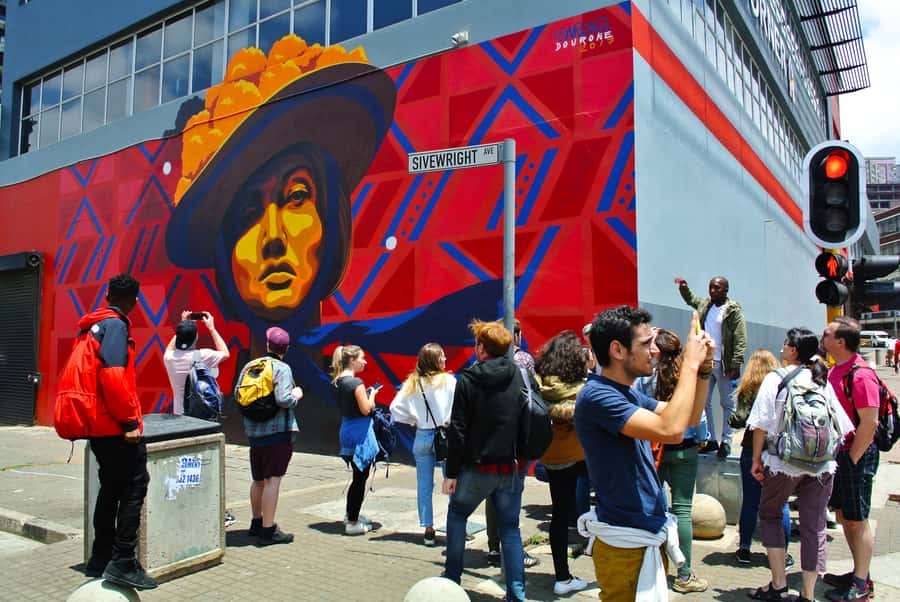
Maboneng means Place of Light. The area has become a center for artists, designers, and small businesses, and the tour uses it as a useful introduction to modern Johannesburg. You might see street art, design work, and signs of the city’s creative culture as you walk through the district.
The experience includes a fresh-brewed cappuccino before setting out. That is a small touch, but it helps the tour feel less like a quick transfer from one attraction to the next. You can meet the guide, ask practical questions, and get oriented before entering busier parts of central Johannesburg.
A safety briefing comes early in the route. Pay attention to it. This is a walking tour through a large city, not a sealed museum visit, and the guide’s local judgment matters. Past descriptions of the route emphasize a street-smart escort, particularly in areas where you may not feel comfortable walking alone.
More City Tours in Johannesburg
- Johannesburg: City Centre Walking Tour
★ 4.8 · 152 reviews - Half Day Pretoria City Tour from Johannesburg or Pretoria
★ 5.0 · 150 reviews - Johannesburg City Centre Walking Tour
★ 5.0 · 80 reviews
Walking through Johannesburg with local context
The most useful feature of this experience is the way it connects places that can feel unrelated on a map. Maboneng’s creative energy, Kwa Mai-Mai’s trading culture, Gandhi Square’s political story, and Main Street’s public art all show different sides of Johannesburg.
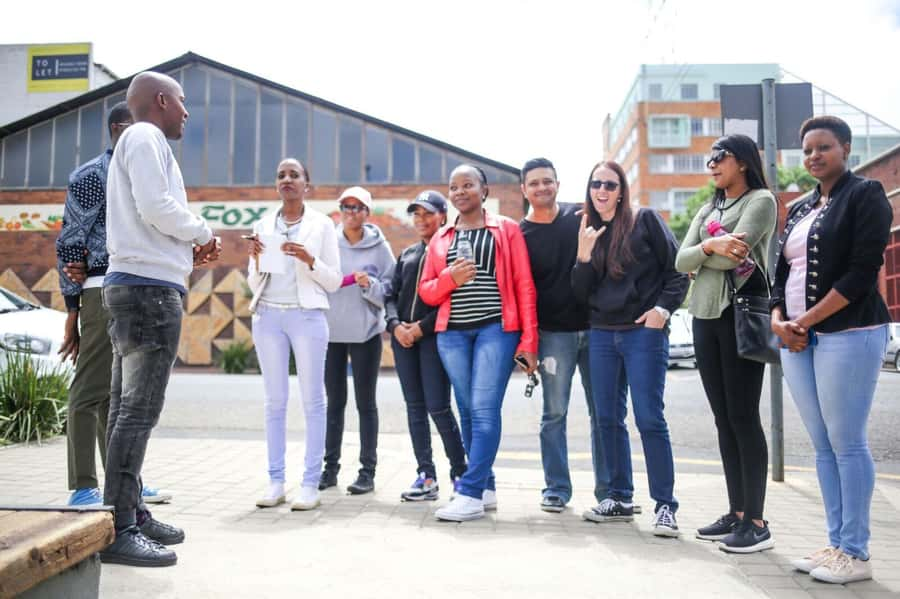
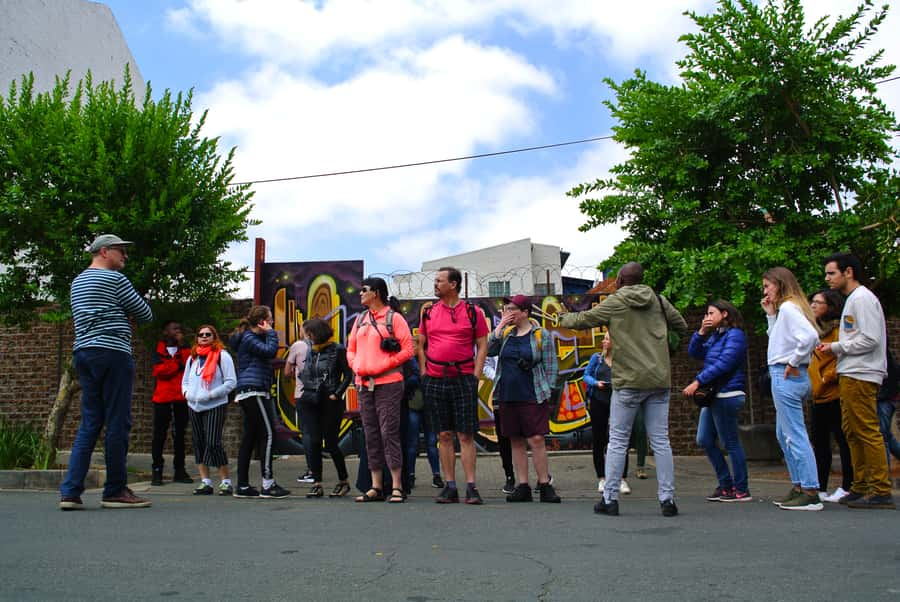
You are not simply driven between photo stops. You walk, use safe public transport, and pass through the city at a human pace. That means you get a better feel for distances, street life, and the changes between districts.
It also means you need to be ready for a physically active four hours. One previous account described a lot of walking, and that is worth taking seriously. Wear comfortable shoes, use sunscreen, bring a hat, and carry a camera if you want to record the murals, buildings, market stalls, and city views.
The tour is conducted in English. The guide’s role is especially important here because Johannesburg can be hard to read on a first visit. A strong guide can explain what you are seeing while helping you move through the city with more confidence. Eco is one guide associated with the route and has been praised for clear information and a relaxed manner.
Kwa Mai-Mai Market and practical souvenir shopping
Kwa Mai-Mai Traditional Market is one of the oldest markets in Johannesburg. This is where the tour shifts from the polished creative district to a more traditional trading environment.
The stalls sell items with a strong local character: traditional medicines, ethnic clothing, beaded jewelry, walking sticks, and handicrafts. If you want a souvenir that feels connected to Johannesburg rather than a generic airport purchase, this is one of the better chances on the route.
Give yourself time to look before buying. The market is part shopping stop and part cultural encounter, so you may want to ask the guide about items that you do not recognize. Traditional medicines in particular deserve respectful attention. A guide can help explain what is being sold, but you should not assume that a product is suitable for personal use simply because it is displayed for sale.
This stop also makes the tour more useful for visitors who want to understand daily commerce. You see how a market works, what local sellers offer, and how goods differ from the art and design associated with Maboneng.
The drawback is simple: market shopping takes as much time as you give it. If you linger over every stall, the later stops may feel rushed. I would decide in advance whether you are mainly looking for a gift or mainly interested in seeing the market itself.
Collector’s Treasury, a book lover’s detour
Collector’s Treasury offers a sharp change of pace. It is the largest second-hand bookstore in the Southern Hemisphere, and it gives the walking route an unusual literary stop.
You may not have expected a bookstore on a Johannesburg city tour, which is part of its appeal. A large used-book collection can reveal the interests, past reading habits, and changing cultural life of a city in a way that a standard monument cannot.
For book lovers, this may be one of the tour’s most memorable stops. For everyone else, it is still a worthwhile pause between the market and the high-rise view. You can browse shelves, take in the atmosphere, and see a side of central Johannesburg that many short sightseeing routes skip.
The supplied details do not specify how long you spend inside, so do not assume you will have unlimited browsing time. Treat it as a guided stop rather than a dedicated bookstore visit. If you are hoping to buy a particular title, ask the guide how much time is available before you start searching.
More Walking Tours in Johannesburg
- Johannesburg: Local Food Tasting Guided Walking Tour
★ 4.7 · 192 reviews - Johannesburg: Guided Walk with Lions in the African Bush
★ 4.7 · 45 reviews - Johannesburg: Hillbrow Walking Tour Including Ponte building
★ 4.8 · 32 reviews - Johannesburg: Private Walking Tour with a Local
★ 4.4 · 17 reviews
Carlton Centre and the city from above
The route then uses a shuttle to reach the Carlton Centre. At 50 stories, the building offers a broad view over Johannesburg and gives you a useful sense of the city’s scale.
From street level, central Johannesburg can feel like a collection of separate districts. From above, the city becomes easier to understand as a large urban area. The view also provides a break from walking and a chance to take photographs.
This is the stop that requires the most careful pre-booking check. One past visit found the viewing area closed for an extended period, even though the tour had been promoted with a high-rise view. Access can change, and the information supplied for this experience does not guarantee that the lookout will always be open.
I would ask the provider directly before paying if the Carlton Centre visit is important to you. If it is available, it adds real value to the tour. If it is closed, the $54 price feels less attractive because one of the headline experiences is missing.
The shuttle ride itself is useful. It means you are not expected to walk every stretch of the route, and it shows how the tour combines public transport with guided walking. Still, this is not a transport tour. You should expect to spend much of the four hours on your feet.
Gandhi Square and Johannesburg’s Indian connection
Gandhi Square is named for Mahatma Gandhi, who spent 21 years in South Africa. The stop gives your guide a chance to explain his time in Johannesburg and place his South African years in the setting where they happened.
This is more than a quick photograph beside a name on a sign. Gandhi’s life in South Africa is an important part of the country’s wider political and social story, and Johannesburg was one of the places where that story developed.
The value here depends on the guide’s explanation. A name and statue alone can be easy to forget. A clear account of Gandhi’s time in the city gives the square meaning and connects it to a wider history of migration, discrimination, protest, and political change.
If you have already studied Gandhi’s life, you may find this stop brief. If you know little about his South African years, it can add useful context to a city that is often presented only through gold, business, and post-apartheid change.
Main Street, Chancellor’s House, and Mandela as a young boxer
The final section takes you along downtown Main Street. This is a fitting place to finish because the route returns to public streets, buildings, and artworks rather than ending at a single enclosed attraction.
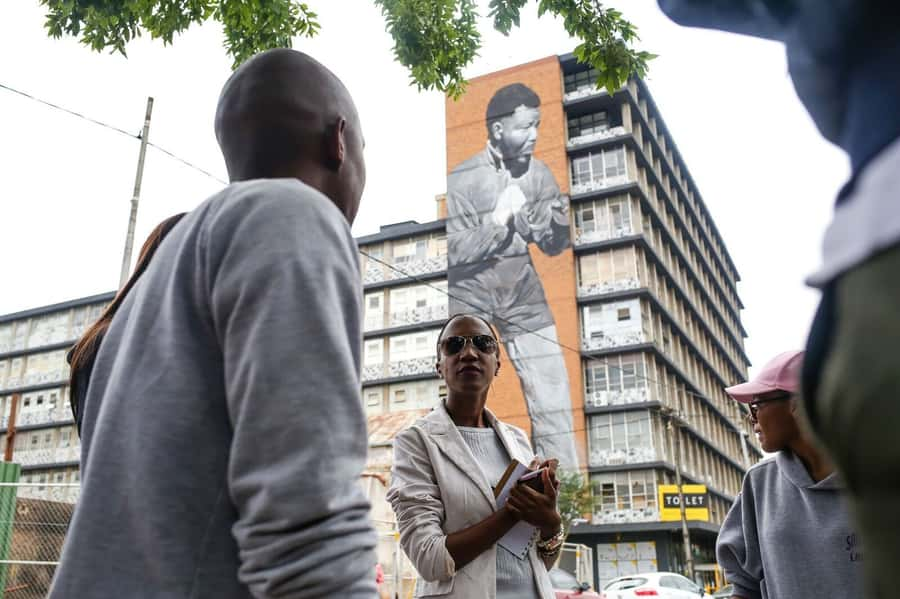
You pass Chancellor’s House and the Shadow Boxing statue. The sculpture shows Nelson Mandela as a young boxer, before he became the country’s president. It offers a more personal image than the familiar statesman portraits and gives you a chance to think about the different stages of his life.
Main Street also brings together many of the tour’s themes: work, politics, public art, and the changing identity of Johannesburg. You have seen the city from a high building, but the final walk puts you back among its buildings and streets.
This last stretch may be especially enjoyable if you like urban photography. The route includes art and architecture rather than a long list of formal landmarks. The past praise for street art and city culture makes sense here, since the guide can point out details you might otherwise walk past.
The activity returns to 302 Fox Street, where it began. That makes the tour easy to fit into a day based in Maboneng, though you will need to arrange your own onward transport or hotel transfer because pickup and drop-off are not included.
What $54 buys you
At $54 per person, the price is easiest to justify if you value local guidance, public transport practice, and access to several different parts of Johannesburg in one half-day.
You are paying for an expert English-speaking guide rather than for a long list of admissions. Food and drinks are not included, although the meeting begins with cappuccino. The route’s value comes from the guide’s interpretation, safety awareness, and ability to connect the stops.
I would compare the cost with what you want from the day:
- If you want independent time at a market or bookstore, the price may feel high.
- If you are new to Johannesburg and want help understanding where to walk and how the districts connect, the price is easier to defend.
- If Carlton Centre access is closed, ask whether the route changes or whether the price remains the same.
- If you enjoy street art, public sculpture, and city culture more than formal museums, this route gives you a useful concentration of those subjects.
The four-hour length is also practical. It is long enough to cover several districts but short enough to leave most of your day open. You can schedule another activity afterward, though I would avoid anything that requires you to be immediately fresh after a long walk.
Who will enjoy this route most
I would choose this tour if you want a first look at Johannesburg that goes beyond a vehicle window. It suits independent-minded visitors who like markets, city streets, public art, books, and local stories.
It is also a good fit if you are nervous about exploring central Johannesburg alone. The guide does not remove every city concern, but moving with someone familiar with the area can make the experience feel more manageable.
You should reconsider it if you have limited mobility, are pregnant, or do not want a walking-heavy outing. The experience is specifically not recommended for people with mobility impairments, and the route includes walking, public transport, and time on city streets.
Bring comfortable shoes, sunscreen, a sun hat, and a camera. Since food and drinks are not included, plan accordingly, though the supplied details do not specify where or when a food break might occur.
Free cancellation is available up to 24 hours before the start, and you can reserve now and pay later. Those terms help if your Johannesburg schedule is still changing, but they do not make the Carlton Centre access issue disappear. Confirm that detail before you commit.
Should you book the City of Gold Walking Tour?
Book it if you want a guided introduction to Johannesburg’s street culture, with market shopping, city views, Gandhi’s story, public art, and a major second-hand bookstore all in one half-day.
I especially like the route’s range. Kwa Mai-Mai Market feels different from Maboneng, Collector’s Treasury is an unexpected stop, and Main Street finishes with memorable public art. The strongest praise has focused on friendly guiding, street culture, and feeling safe while walking through areas that can be difficult to judge on your own.
I would not book without checking Carlton Centre access if that view is central to your plans. Otherwise, this is a practical choice for a first visit, provided you are comfortable walking and understand that the $54 fee pays mainly for the guide and the route, not meals or a large package of included admissions.
FAQ
Where does the Johannesburg City of Gold Walking Tour begin?
The meeting point is CURIOCITY Joburg hostel at 302 Fox Street in the Maboneng Precinct. You should arrive 15 minutes before the activity begins.
How long does the tour last?
The tour lasts four hours and returns to 302 Fox Street.
What language is the tour conducted in?
The tour is conducted in English with a live local guide.
Is hotel pickup and drop-off included?
No. Hotel pickup and drop-off are not included. You meet the guide at CURIOCITY Joburg hostel and return to 302 Fox Street.
What should I bring?
Bring comfortable shoes, a sun hat, sunscreen, and a camera. Food and drinks are not included.
Is the tour suitable for people with limited mobility?
No. The tour is not recommended for people with limited mobility and is listed as unsuitable for people with mobility impairments and pregnant women.
Just added around Johannesburg
- 13 Day Safari – Cape Town to Johannesburg★ 5.0 · 11 reviews
- Tala Game Reserve & Natal Lion Park 1/2 Day Tour from Durban★ 3.0 · 13 reviews
- South Africa from Joburg: Elephant Sanctuary Half Day Tour★ 5.0 · 3 reviews
- Private Safari Tour: Pilansberg National Park Big 5★ 5.0 · 7 reviews
- Johannesburg: Elephant and Monkey Sanctuary Half Day Tour★ 5.0 · 3 reviews
- Johannesburg: Wine Tasting and Cableway Half Day Tour★ 4.7 · 3 reviews
- Pretoria: Pretoria City and Lion Park Tour★ 4.8 · 41 reviews
- Lion Park Tour in Open Safari Vehicle★ 5.0 · 6 reviews
City Tours, compared.
Cape Town Hop-On Hop-Off City Tour with Optional Cruise
Read our review →
Johannesburg Hop-On Hop-Off City Tour with Soweto Option
Read our review →
Jo’berg in 1 Day: Soweto, Apartheid Museum & City Tour
Read our review →
Cape Town City Pass: Save Over 50% on 80+ Top Attractions
Read our review →
Hop-On Hop-Off Bus, City Tour and Apartheid Museum
Read our review →
Browse the lists this tour appears in